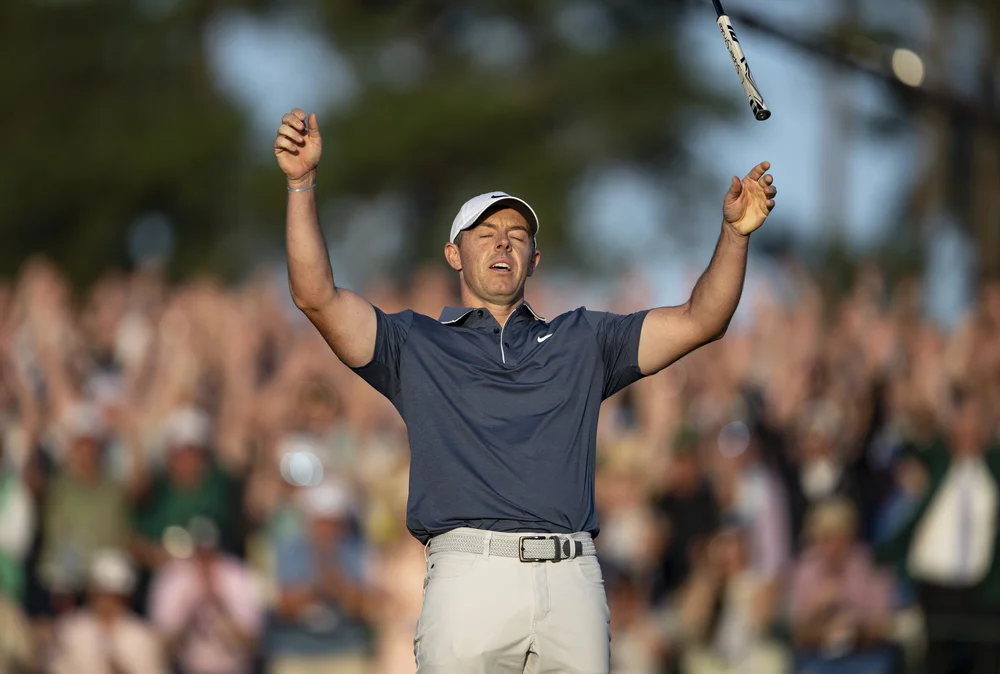
Rory McIlroy celebrating his triumph at Augusta National.
English Article
The highly anticipated documentary, “Rory McIlroy: The Masters Wait,” set to premiere on Amazon Prime, delves deep into the golfer’s arduous yet ultimately triumphant journey to capture the coveted green jacket. More than just a recount of his athletic achievements, the film offers a poignant look through the eyes of his parents, Rosie and Gerry, whose unwavering support and personal sacrifices shaped his path.
Rosie and Gerry, who juggled multiple jobs to fuel Rory’s dreams, experienced every high and low alongside him. From the crushing collapse in 2011 to the tense back-nine moments of last year’s tournament, and finally, the euphoria of his playoff victory over Justin Rose – which McIlroy himself described as finally catching his “white whale” – their journey is central to the narrative.
Produced in collaboration with McIlroy’s Firethorn Productions, the documentary chronicles his 2025 Masters win, completing his Career Grand Slam. It explores everything from his childhood aspirations of winning all four majors to the “imposter syndrome” he felt during the 17 years the Masters title eluded him. The film masterfully weaves together archival footage, intimate interviews, and critical moments from that historic final round, presenting a comprehensive and emotionally charged narrative of triumph at Augusta.
Beyond the stunning visuals and inherent drama, the documentary truly shines in its portrayal of McIlroy’s vulnerability. It exposes the emotional “baggage” he carried to Augusta each year and his relentless struggle to overcome the lingering trauma of squandering a four-shot lead in the final round of 2011. Parents watching will undoubtedly empathize with Rosie and Gerry, witnessing their son’s arduous pursuit of his lifelong dream.
Recalling the aftermath of the 2011 disappointment, Rosie tearfully recounts their phone call: “Of course, I was crying. He was crying. The way he was carrying himself on the golf course just wasn’t him at all.” Gerry adds that the mere mention of the Masters would make Rory “edgy” in the years leading up to his victory, observing that “he was trying too hard.” When McIlroy nearly faltered again last year, Gerry admits he had to “pour Rosie a drink to calm her down,” and took one himself, as the tension was palpable.
McIlroy openly credits consulting psychologist Dr. Bob Rotella as a pivotal factor in his Grand Slam success. He confessed to being “stubborn” and reluctant to seek help, believing he could solve issues independently. However, a turning point came in 2017 when, struggling, he listened to Rotella’s audiobook, “Golf is not a Game of Perfect,” during a drive between tournaments.
Upon his eventual victory, Rosie’s reaction perfectly encapsulates the magnitude of the moment. “When that last putt went in, you couldn’t have stopped me crying for love nor money,” she stated, recalling two and a half hours of tears. She always believed in him, recognizing his “very special” nature, especially given that only six players in history have achieved the career Grand Slam.
The film includes newly shot footage at Augusta, capturing McIlroy’s precise club regripping and target focus before executing his iconic 20-yard hook with a seven-iron from behind the trees on the par-five 15th hole. “I stood up, and I made the most trusting, committed swing,” he recounts. “I knew it as soon as I hit it.” Even golf legend Jack Nicklaus, who had advised patience years prior, hailed it as “one of the most fantastic shots I’ve ever seen,” noting few would have dared attempt it.
The documentary also touches upon a lighter, yet revealing, moment: McIlroy’s strategic standoff with Bryson DeChambeau on the ninth green regarding who would putt first for birdie. McIlroy humorously recounted rejecting DeChambeau’s casual suggestion to “throw a tee up” for it, asserting, “No, this is the final round of the Masters. This isn’t some like game on a Tuesday afternoon somewhere. I wasn’t going to wilt in that situation, I was just going to stand firm.” This seemingly minor interaction highlights McIlroy’s competitive resolve.
Reflecting on his triumph, McIlroy considers the Masters his “white whale” – caught but never fully tamed. He emphasizes that the victory doesn’t guarantee future faultless play but signifies something deeper. “I’m proudest of not losing hope,” he concludes, underscoring the persistence and inner strength he found to keep returning and striving for his ultimate goal.
Artículo en Español
El esperado documental “Rory McIlroy: La Espera del Masters”, que se estrenará en Amazon Prime, se adentra en el arduo pero finalmente triunfante viaje del golfista para conseguir la codiciada chaqueta verde. Más que un mero relato de sus logros deportivos, la película ofrece una mirada conmovedora a través de los ojos de sus padres, Rosie y Gerry, cuyo apoyo inquebrantable y sacrificios personales moldearon su camino.
Rosie y Gerry, quienes trabajaron en múltiples empleos para impulsar los sueños de Rory, experimentaron cada momento de éxito y fracaso junto a él. Desde el devastador colapso en 2011 hasta los tensos momentos en los últimos nueve hoyos del torneo del año pasado, y finalmente, la euforia de su victoria en el desempate contra Justin Rose – que el propio McIlroy describió como la captura de su “ballena blanca” – su viaje es fundamental para la narrativa.
Producido en colaboración con Firethorn Productions de McIlroy, el documental narra su victoria en el Masters de 2025, con la que completó su Grand Slam de Carrera. Explora desde sus aspiraciones de infancia de ganar los cuatro majors hasta el “síndrome del impostor” que sintió durante los 17 años en que el título del Masters se le escapó. La película entrelaza magistralmente imágenes de archivo, entrevistas íntimas y momentos clave de esa histórica ronda final, presentando una narrativa completa y emocionalmente cargada del triunfo en Augusta.
Más allá de los impresionantes visuales y el drama inherente, el documental brilla verdaderamente en su retrato de la vulnerabilidad de McIlroy. Expone el “equipaje” emocional que llevaba a Augusta cada año y su incansable lucha por superar el trauma persistente de perder una ventaja de cuatro golpes en la ronda final de 2011. Los padres que vean la película sin duda empatizarán con Rosie y Gerry, al presenciar la ardua búsqueda de su hijo por el sueño de su vida.
Recordando las secuelas de la decepción de 2011, Rosie relata entre lágrimas su llamada telefónica: “Claro que estaba llorando. Él estaba llorando. La forma en que se comportaba en el campo de golf no era él en absoluto.” Gerry añade que la mera mención del Masters ponía a Rory “nervioso” en los años previos a su victoria, observando que “se esforzaba demasiado.” Cuando McIlroy casi flaqueó de nuevo el año pasado, Gerry admite que tuvo que “servirle una copa a Rosie para calmarla,” y también tomó una él mismo, ya que la tensión era palpable.
McIlroy atribuye abiertamente la consulta al psicólogo Dr. Bob Rotella como un factor fundamental en su éxito en el Grand Slam. Confesó ser “terco” y reacio a buscar ayuda, creyendo que podía resolver los problemas de forma independiente. Sin embargo, un punto de inflexión llegó en 2017 cuando, en un momento de dificultad, escuchó el audiolibro de Rotella, “Golf is not a Game of Perfect,” durante un viaje entre torneos.
Tras su eventual victoria, la reacción de Rosie encapsula perfectamente la magnitud del momento. “Cuando ese último putt entró, no podrías haberme impedido llorar por nada del mundo,” afirmó, recordando dos horas y media de lágrimas. Ella siempre creyó en él, reconociendo su naturaleza “muy especial,” especialmente dado que solo seis jugadores en la historia han logrado el Grand Slam de Carrera.
La película incluye metraje recién filmado en Augusta, que captura el preciso agarre del palo de McIlroy y su enfoque en el objetivo antes de ejecutar su icónico golpe de gancho de 20 yardas con un hierro siete desde detrás de los árboles en el par cinco del hoyo 15. “Me levanté y realicé el swing más confiado y comprometido,” relata. “Lo supe tan pronto como lo golpeé.” Incluso la leyenda del golf Jack Nicklaus, quien le había aconsejado paciencia años antes, lo calificó como “uno de los golpes más fantásticos que he visto,” señalando que pocos se habrían atrevido a intentarlo.
El documental también aborda un momento más ligero, pero revelador: el estratégico enfrentamiento de McIlroy con Bryson DeChambeau en el green del hoyo nueve sobre quién debería patear primero para birdie. McIlroy relató con humor cómo rechazó la sugerencia informal de DeChambeau de “lanzar un tee” para decidir, afirmando: “No, esta es la ronda final del Masters. Esto no es un juego cualquiera de un martes por la tarde. No iba a ceder en esa situación, simplemente me mantendría firme.” Esta interacción aparentemente menor resalta la resolución competitiva de McIlroy.
Reflexionando sobre su triunfo, McIlroy considera el Masters su “ballena blanca” – capturada pero nunca completamente domada. Enfatiza que la victoria no garantiza un juego impecable en el futuro ni la ausencia de dificultades en el Masters, sino que significa algo más profundo. “Estoy más orgulloso de no perder la esperanza,” concluye, subrayando la persistencia y la fuerza interior que encontró para seguir regresando y esforzándose por su objetivo final.